Google Gemini 3.8 Flash highlights programming and cybersecurity capabilities
Google released Gemini 3.8 Flash in a short period of time, including the standard version and a dedicated cybersecurity version, with significant improvements in programming capabilities.
Google focuses on the lightweight version of Flash.
Since 2026, Google has not made any new developments on the high-end Gemini Pro model. In sharp contrast, the Gemini Flash series of small models have been updated at a high pace. Gemini 3.8 Flash, the third Flash version released within six weeks, has led many in the market to speculate that the originally planned Gemini 3.5 Pro is unlikely to be released to the public. Google did not directly respond to this speculation but emphasized that the new version of Flash already has strong capabilities and is the best model in the company for reasoning and code tasks at present.
Flash belongs to lightweight large models and is not in the same category as Pro and Ultra type giant models. It does not require massive computing power support, has a fast response speed, and is suitable for frequent calls. In recent times, the entire AI industry has been shifting towards these types of models. Enterprise customers place more emphasis on cost and are unwilling to continuously pay high API fees for daily tasks. Manufacturers no longer blindly pursue making larger models but instead focus on enhancing the comprehensive capabilities of medium-sized models.
The low-price window period attracts developers to join in.
This time, Google released two branches at once. The regular version, Gemini 3.8 Flash, was defined as the main model for general use, covering various scenarios such as intelligent agent tasks, daily development, and text processing. The other one is Gemini 3.8 Flash Cyber, whose underlying architecture is consistent with the standard version, and it is specifically optimized for vulnerability mining and security repair scenarios. Google set a phased discount price for 3.8 Flash, with the rules remaining the same as the previous generation 3.7 Flash. The discount period lasts until the end of this year, with an input token of $0.75 per million and an output token of $3.75 per million. When the discount ends, the price will double, with an input token of $1.5 per million and an output token of $7.5 per million.
Industry competition is an important reason for Google's price reduction. Recently, several AI companies have successively lowered the API call prices, making enterprise customers more cautious when choosing tools. Simply competing on model performance is no longer enough; call costs have become the core indicator for enterprises when selecting tools. The pricing strategy can attract developers and small and medium-sized enterprises to join Google's API, and in turn, continue to optimize the model. The discount model also hides a rhythm. The low-price window will not be permanently open. Google continuously releases new versions during the discount period. This approach can continuously retain developers and keep them in Google's ecosystem to test their business, avoiding customers directly turning to competitors.
The code capability has ranked first on the list.
Google released a series of benchmark test data to compare the new and old models with competitors. Overall, 3.8 Flash only showed a slight improvement compared to 3.7 Flash, but the code-related tests had an extremely significant increase. On the DeepSWE list, which specifically assesses complex software engineering capabilities, Gemini 3.8 Flash achieved the top position. Previously, it was reported that Gemini 3.5 Pro was postponed for release because its code capability could not keep up with the competition at the same time. Now that the lightweight Flash model has filled this gap, Google can directly compete with market-leading models using the Flash series.
Not all projects can achieve high scores. In the OSWorld-2.0 test, this test measures the ability of AI agents to directly operate the computer. The new version has made progress compared to 3.7 Flash, but there is still a considerable gap from Claude Opus. The GPT series also did not perform particularly well in this test project. Computer operation agents are a difficult point in the current AI field. The model needs to understand the content on the screen and complete multiple consecutive operations, with a high cost of error. Even if the model is strong in text and code, it is difficult to achieve a rapid breakthrough in this task.
Gemini 3.8 Flash Cyber is designed for professional scenarios.
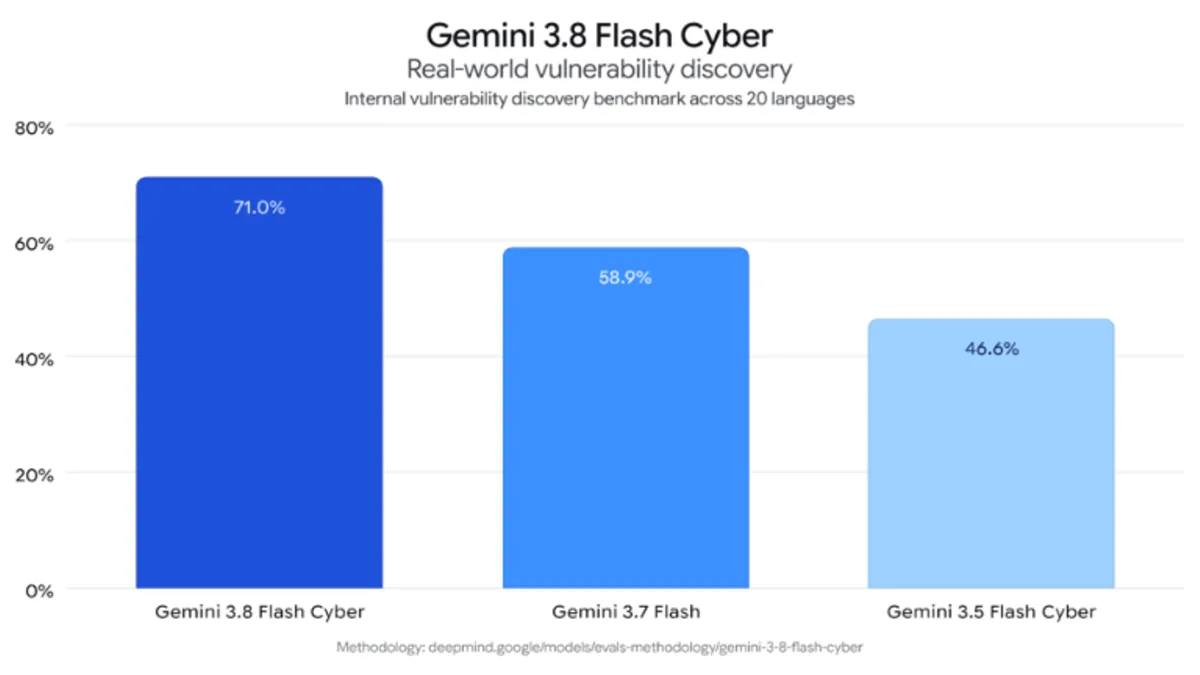
Gemini 3.8 Flash Cyber is an upgraded version of the previous 3.5 security model. Ordinary users will rarely come into contact with this version. Its target customers are cybersecurity teams, cloud service providers and government agencies. Data from Google's internal testing shows that the new version has greatly improved its ability to detect vulnerabilities and generate feasible repair solutions. Feedback from the Chrome security team shows that the accuracy of the framework's output patches has increased by 2.6 times. In the cloud team's test cases, the model located the key security vulnerabilities in just two hours.
The demand for AI in the security field is quite unique. The model not only needs to understand the syntax of the code but also needs to comprehend the logical flaws hidden deep within the code. It needs to distinguish harmless code segments from potentially exploitable high-risk vulnerabilities and write repair code that can be directly implemented. Such scenarios cannot be simply handled by a general model. However, this version has a limited scope of availability. During the initial launch, it was only open to screened trusted testers and government agencies, and would not be directly placed in the public API.
The competition logic in the large model field has changed.
The standard version of Gemini 3.8 Flash has been launched in the Google ecosystem. When using this model in the Gemini App, users need to subscribe to the Pro or Ultra packages. If developers want to have a free trial, they can directly enter the AI Studio platform for testing. The access permissions for the two versions have been differentiated, taking into account both the trial of ordinary developers and the experience of paid users.
This intensive update of the Flash series by Google is driven by the shift in the development thinking of the AI industry. In the previous two years, various manufacturers competed based on the size of model parameters, and the one with the larger model size was more likely to attract attention. Now the trend has changed. Customers are more concerned about cost-effectiveness. Many business scenarios do not require extremely large models. Lightweight models only need sufficient inference and code capabilities. The research and development costs of high-end large models remain high, and Google has postponed Gemini 3.5 Pro and instead continuously iterated Flash, which is a choice made based on market demand.