Google's AI weather model undergoes iterative upgrades - WeatherNext 3
Google has launched a new WeatherNext 3 weather AI model, which uses real-time satellite data and has increased the accuracy of the forecast. However, it still has some technical flaws.
The main advantages of the AI meteorological model: low cost and high frequency computing.
Traditional weather forecasting relies on supercomputers to calculate complex atmospheric physical formulas, ensuring stable accuracy. However, its shortcomings are quite obvious. The equipment has high power consumption and the computing cost is expensive, making it impossible to frequently update the forecast data. Once the weather changes suddenly, the old data is difficult to match the real-time weather conditions in time. The AI meteorological model developed by Google, compared with traditional physical models, has lower hardware computing power requirements and lower operating costs.
While maintaining the same or even better forecast accuracy, the AI model can perform high-frequency repetitive calculations, quickly update weather data, and adapt to the changing meteorological scenarios. Most of the AI meteorological models available on the market previously relied heavily on "reanalysis data" for training. This data integrates scattered meteorological observation information worldwide and assembles it into a complete global atmospheric picture. However, it is updated only once every six hours, with a long time interval. Compared to the rapidly changing weather, the data is seriously lagging behind.
Accessing satellite data, saying goodbye to six-hour data lag.
The latest WeatherNext 3 model released by Google has the greatest technological breakthrough in breaking free from the limitations of pure reanalysis data. The research team added real-time meteorological satellite observation data as input materials for the model, solving the problem of data delay in the old model. Previously, AI models could only passively use integrated data updated every six hours, resulting in a severely delayed forecast rhythm. The new model relies on high-definition satellite images and can update the forecast results every hour, improving the timeliness.
In addition, the overall scale of the model has been further expanded, the spatial resolution has been improved, and the depiction of local weather details has become more accurate. To avoid the computational burden caused by large models, the research team optimized the processing flow and balanced accuracy and computing efficiency. For the difficult issue of precipitation forecasting, the team specially trained an independent satellite precipitation estimation sub-model.
Break through the limitations of the black box and integrate real geographical and physical information.
Traditional AI meteorological models are generally typical "data black boxes". They do not understand the atmospheric physical logic and can only complete predictions by learning a large amount of historical meteorological data and matching the weather change patterns. There are obvious shortcomings in local precise forecasting. WeatherNext 3 specifically addressed this loophole by adding lightweight physical rules in the pure data simulation. The model can automatically identify the attributes of the location, distinguish between land and sea scenarios, and incorporate geographical information such as altitude.
The research team trained the model using measured meteorological station data with annotated geographical information, allowing the AI to no longer rely solely on data patterns but also to conform to the physical change logic of the real geographical environment. This fine-tuning brought significant improvements. The accuracy of surface temperature prediction at some points increased by up to 30%, the accuracy of high-altitude atmospheric forecasting improved by 5%, and the effective forecasting duration increased by six hours.
The performance of the model is not stable.
WeatherNext 3 is not a perfect model. During actual testing, multiple flaws were exposed, and there is still room for algorithm optimization. In the medium and long-term forecasting scenarios, abnormal problems occurred in the model's performance. The data shows that the accuracy is extremely high in the first six hours of the forecast, but in the subsequent 15-day long-term predictions, the accuracy is inferior to the previous generation model and similar competitors, and the stability is insufficient.
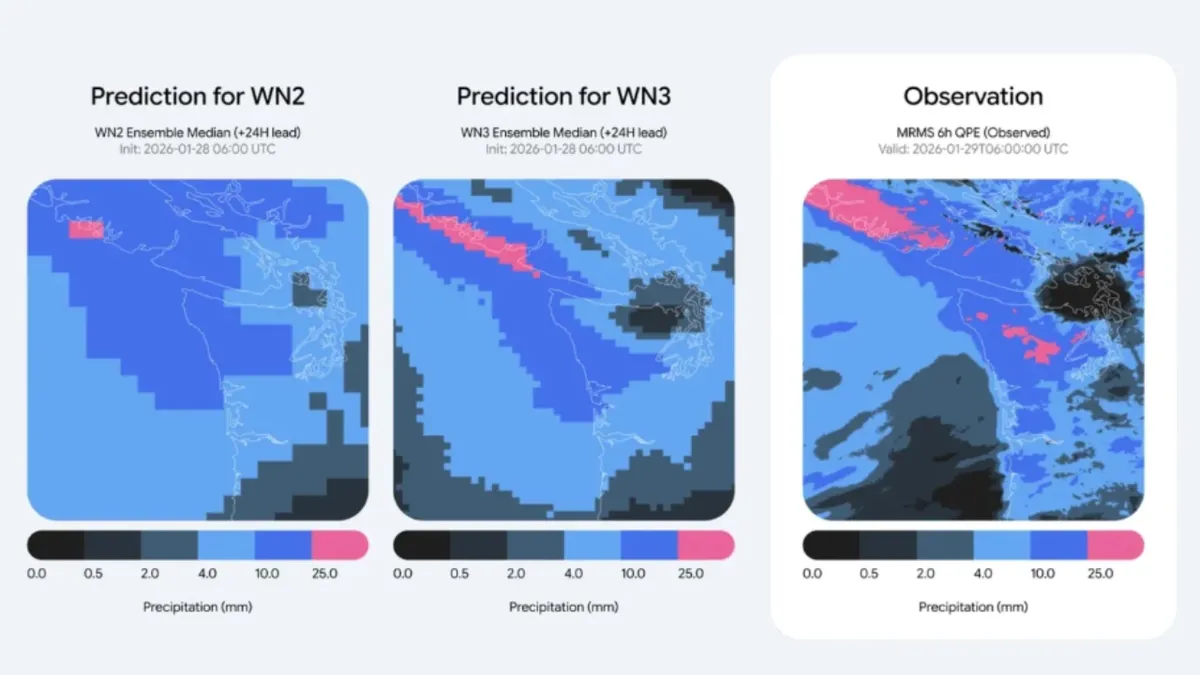
The visualization of forecast images also has obvious flaws. In the precipitation forecast map, hexagonal grid patches regularly appear, which are artificial traces inherent to the model algorithm and do not match the actual natural precipitation distribution pattern. At the same time, the global average temperature data output by the model often fluctuates abnormally, rising and falling unpredictably, unable to maintain a stable average, and violating the basic laws of atmospheric changes. Additionally, the model can not reasonably balance global and local data.
Even with some minor flaws, WeatherNext 3 still represents the current cutting-edge level of AI weather forecasting. Its greatest industry value lies in breaking the inherent mode of AI models that solely rely on historical integrated data, combining real-time observation data, geographical and physical information, and big data training, and taking a new technical route. Currently, in the Google ecosystem, the temperature, precipitation, and weather trend information queried by ordinary users is generated in real time by WeatherNext 3.