The Indian stock market suffered a double blow from oil prices and US treasuries
The market has been under pressure from a slew of negative factors with the two major benchmark indices in India plunging to five-month lows.
The entire market weakened across the board, and the declines of small-cap stocks were even more severe.
On September 15th, the Indian stock market was under pressure overall. The two core benchmark indices declined. The Nifty 50 index closed down 1.19% at 23,118.6 points, a new five-month closing low. Another major index, BSE Sensex, also retreated, with a 1.04% decline, closing at 74,003.82 points. This adjustment was not a sudden market fluctuation in a single day, the market adjustment cycle had already begun. Data showed that the index had been fluctuating downward in the past five weeks, with a decline of 4.8%.
During the closing bidding stage, the selling pressure on the market intensified further. The Nifty 50 index's maximum decline once reached 2.2%. After the regular trading period ended, the decline narrowed slightly, but still maintained a nearly 1% drop. At the industry level, it was a general decline pattern, with as many as 15 out of the 16 major industry sectors closing in the red, and the market's profit effect was extremely low. Small-cap stocks became the hardest-hit area. The small-cap index dropped by 2.4% on the day, and the mid-cap index fell by 2.1%.
Oil prices and U.S. treasury yields are exerting pressure on the market.
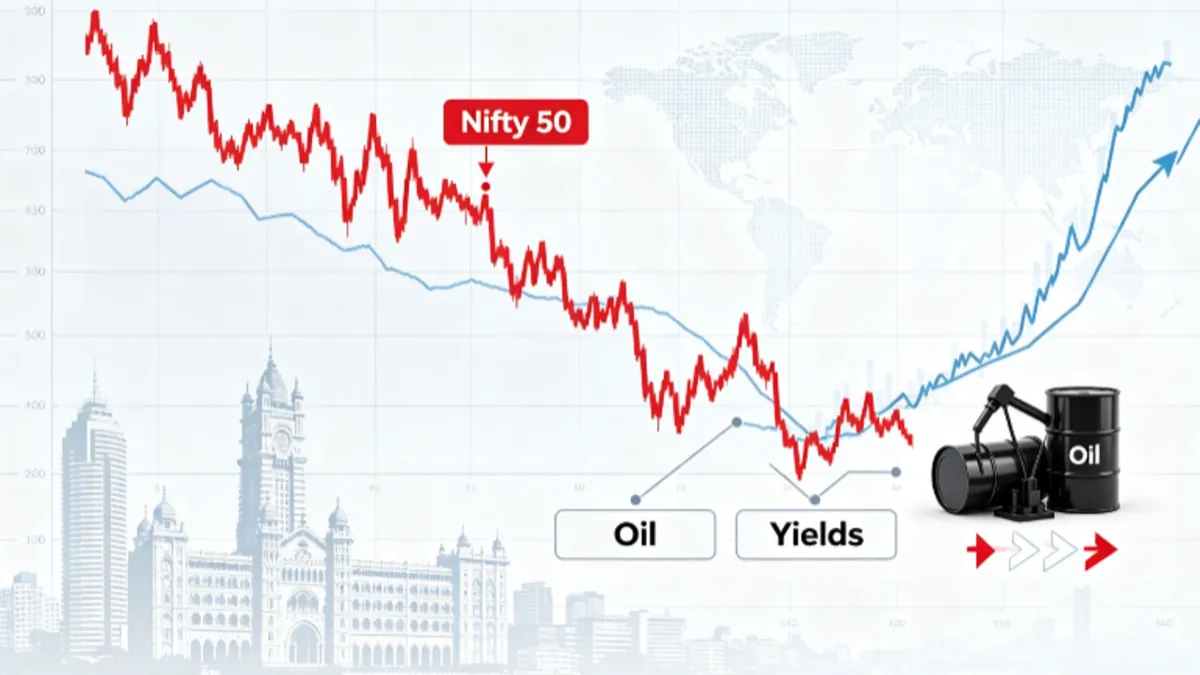
The recent sharp decline in the Indian stock market was mainly caused by the combined impact of two major external negative factors. Firstly, the escalating geopolitical situation in the Middle East pushed up international oil prices, largely intensifying inflation concerns in the Indian market. The increase in regional conflicts, with the Houthi group attacking Saudi Arabia, has quickly escalated the risk to the security of global energy shipments. Brent crude oil futures jumped 2% in a day to close at a high of $107.8 per barrel. India is a country heavily dependent on imported crude oil and the rise in oil prices will further increase domestic production and consumption costs and add further pressure on inflation.
Secondly, the ripple effect caused by changes in the global bond market. The yield of the U.S. 10-year Treasury has continued to rise, reaching a new high in the past two decades. The market generally predicts that the Federal Reserve meeting is likely to initiate an interest rate hike due to inflationary pressure. As a typical emerging market, the pressure on foreign capital outflows in the Indian stock market has increased. High oil prices, high U.S. Treasury yields, coupled with the recent series of IPOs that divert funds, are the core reasons for the current continuous weakness in the Indian market.
The financial and automotive sectors led the decline in the overall market, with only IT and leading bank stocks rising.
The entire financial sector was underperforming. India's NIFTYFIN financial index was down 1.8% in a day. Most banking and non-banking financial stocks dropped along with the market. The auto sector had a bigger loss. The NIFTYAUTO index went down 2%. The car industry is very sensitive to inflation and interest rates. Higher oil prices increase the cost of cars. Higher interest rates increase the cost of car loans. This makes people less likely to buy cars and lowers sales forecasts. As a result, nearly all stocks in this sector fell together.
The IT services sector bucked the trend and outperformed even as the overall market declined. The NIFTYIT index surged 2.2% in a single day, bucking the market's downward trend. Tata Consultancy Services, India's biggest software company, rose 2.3% while Infosys was even more impressive, climbing 3.8% in a single day. This is related to the changes in the global AI industry sentiment. As the expectation of industry cooling settles, market concerns about Indian outsourcing IT companies have eased, and funds have flowed back accordingly.
In the past year, the IT sector has underperformed the market. The main reason was market concerns that new AI technologies would replace traditional outsourcing business. This rebound is a valuation recovery. Apart from the IT sector, India's largest private bank HDFC Bank also broke through the trend and rose, with a single-day increase of 1.2%. The bank's rise has clear positive catalysts, stable management changes, and have dispelled market concerns about the company's operational uncertainties.