Yttrium has become a global strategic hotspot
Yttrium is a sort of associated rare earth metal. China's export control has disrupted the overseas supply chain. Geopolitical conflicts have changed the price of yttrium oxide.
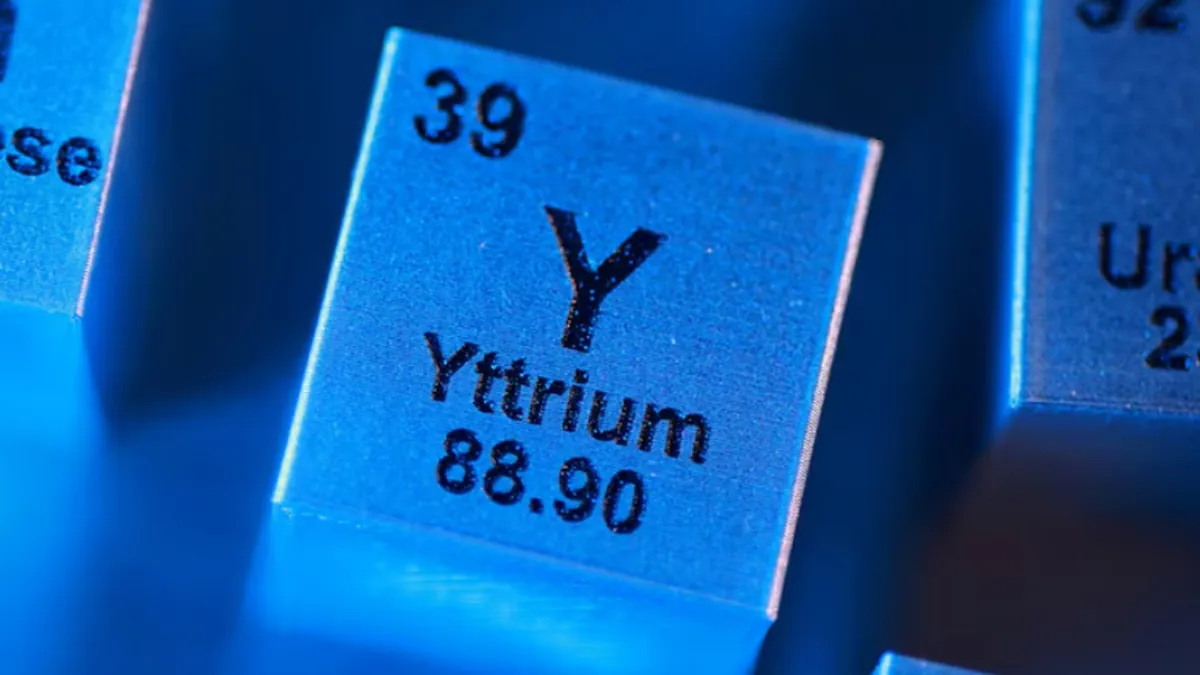
An inconspicuous companion metal - yttrium.
Many people are not familiar with yttrium. It is not classified as a rare earth element, but it occurs naturally along with rare earth ores. It was discovered in a small town in Sweden in the 18th century. The global annual production of mines is roughly between 10,000 and 15,000 metric tons, and the transparency of production data is relatively low. The industrial value of yttrium is concentrated in thermal barrier coatings, which are used to protect aircraft engines from high temperatures. The demand from aerospace, defense and high-end manufacturing has drawn attention to this metal.
In April 2025, China included yttrium along with six other rare earth items in its export control list. Exporters are required to submit documents proving that these metals can only be used in civilian fields. After the policy was implemented, the delivery of yttrium oxide to the United States became intermittent and no longer provided stable and large-scale supplies. Forward contracts immediately began to factor in the expected supply contraction, and the contract prices quickly rose.
The US is highly dependent on imported yttrium.
The domestic production capacity in the US is limited, and the supply chain is highly dependent on overseas sources. After the regulations were enforced, the export of yttrium oxide was not completely banned, but rather intermittent. It was released in small quantities in batches. After several rounds of high-level talks, two batches of yttrium oxide arrived in the US. One was delivered in March with 60 tons, coordinated by the White House to help local large enterprises obtain export licenses. The other was in July, with 29 tons of goods completed for shipment. During most other periods, the Chinese export window was closed.
Whenever there was news of possible export release, the geographical premium for forward contracts would fall. Once supply was again suspended, buying orders quickly entered the market, pushing up the price. Traders do not only look at the current spot inventory, they are more likely to predict whether they can obtain export licenses in the next few months. The US domestic coating industry was forced to suspend production due to raw material shortages. Aerospace and semiconductor companies began to lock in prices in advance to avoid future price hikes.
China tightens its export policy to Japan.
The control over yttrium not only affects the United States, but also puts pressure on Japan. After Japan expressed its stance on the Taiwan Strait issue, China's export of yttrium to Japan almost came to a halt, and other key metals such as terbium and terbium oxide were also restricted. Although Japanese enterprises have established strategic reserves, the high-end manufacturing process still can not do without Chinese supply. In May and June, nearly 200 company announcements mentioned that export restrictions would have a negative impact on business operations.
There is a huge gap in the quotations of yttrium in the Asian, European and North American markets, attracting cross-regional arbitrage funds to participate in the transactions. This cross-regional arbitrage involves significant risks. Ordinary bulk commodities can rely on shipping to quickly allocate supplies and narrow the price gap, but yttrium is subject to export license restrictions. Even if the price gap is large, it is difficult for the goods to be freely transferred. The price gap can persist for a long time and will not be quickly repaired. The EU Trade Representative has proposed that the key mineral export control issues should be resolved by October, otherwise alternative solutions will be adopted.
The supply elasticity is extremely low.
The global production and beneficiation capacity of yttrium is highly concentrated in China. The domestic authorities do not disclose the detailed production quotas for mining and beneficiation. Even if foreign countries want to build new mines, from exploration to mining and purification separation, it will take a long time. In the short term, it is difficult to release sufficient production capacity to offset the gap.
When crude oil and copper prices rise, mines can increase production quickly. However, yttrium is a by-product metal and is not the main product of mines. Therefore, no new mines will be built specifically for yttrium. Even if the price surges, the increase in new production is very limited. The supply elasticity is weak, which means that once there is a supply disturbance, the price is likely to jump largely.
The multiple risks faced by futures traders.
When engaging in the forward trading of yttrium oxide, traders have to confront multiple layers of uncertainties. The primary risk is the policy pace. The approval standards for export licenses in China can be adjusted at any time, and each round of diplomatic negotiations may change the supply expectations, leading to rapid fluctuations in contract prices.
The second risk is the progress of alternative material research. If the aviation coating and semiconductor industries find substitutes for yttrium, the forward demand expectations will be lowered, and the valuation of long-term contracts will be under pressure. If the research on new materials progresses slowly, and high-end manufacturing continues to rely on yttrium, the forward contracts will remain at a high level. All countries are promoting supply chain autonomy, and the US, the EU and Japan are all looking for new mineral sources.